

A beautifully illustrated promotional card from the French chocolate makers Chocolat-Révillon. The back includes full instructions for playing French Loto. Loto is what the French called Bingo at the time. The game goes by many names: house, housey-housey, loto, lotto, keno, beano, Bango, box and numbers, screeno, marko, tombola, and, of course, Bingo.
The French have traditionally played for a line, known as ‘quine’, which is Latin for “five each” or “five at a time.” They also play Dolphin Loto (I have no idea why it is called that), where they play for two, three and four numbers on a line (see the translated instructions below). And while we play for a full house, according to the card, they call that a Tombola. In the UK, Tombola was the Royal Navy’s name for bingo.
This card has no date, but we do know Révillon was founded in 1898, and the clothes pictured are contemporary to the turn of the 20th century. Camis et Cie, a prominent Parisian printing company at the time, published the card, which again ties into it being from the early 2oth Century.
Translated instructions:
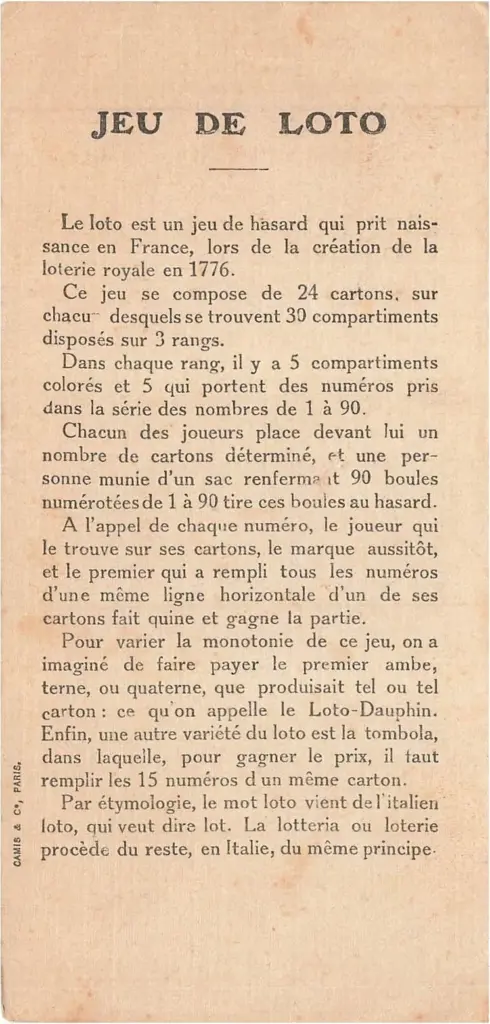 LOTO GAME
Loto is a game of chance that originated in France with the creation of the royal lottery in 1776.*
The game consists of 24 cards, each featuring 30 spaces arranged in 3 rows.**
In each row, there are 5 coloured spaces and 5 spaces containing numbers from the series 1 to 90.
Each player places a set number of cards in front of them, while a person holding a bag containing 90 balls—numbered 1 through 90—draws them at random.
As each number is called, any player who has that number on one of their cards marks it immediately. The first player to complete all the numbers in a single horizontal row on one of their cards achieves a “quine” and wins the game.
To add variety and break the monotony, a variation known as “Loto-Dauphin” was devised, in which players could win a payout for the first ambe (two numbers), terne (three numbers), or quaterne (four numbers) completed on a card.
Another variation of loto is the tombola, in which a player must fill all 15 numbers on a single card to win the prize.
Etymologically, the word “loto” comes from the Italian loto, meaning “lot” (or share/prize). In Italy, the lotteria (lottery) is based on this same principle.
*The lottery originated in Italy, but as this is a promotional item for French Chocolate, we will give them a little license to deviate.
**I think they have made an error here, as 90 Number Bingo cards have 9 columns and three rows, with 27 squares (not 10 columns and 30 squares). 27 squares give you 15 numbers and 12 spaces per card: see 90 Number Bingo Tickets Explained





Leave A Comment