
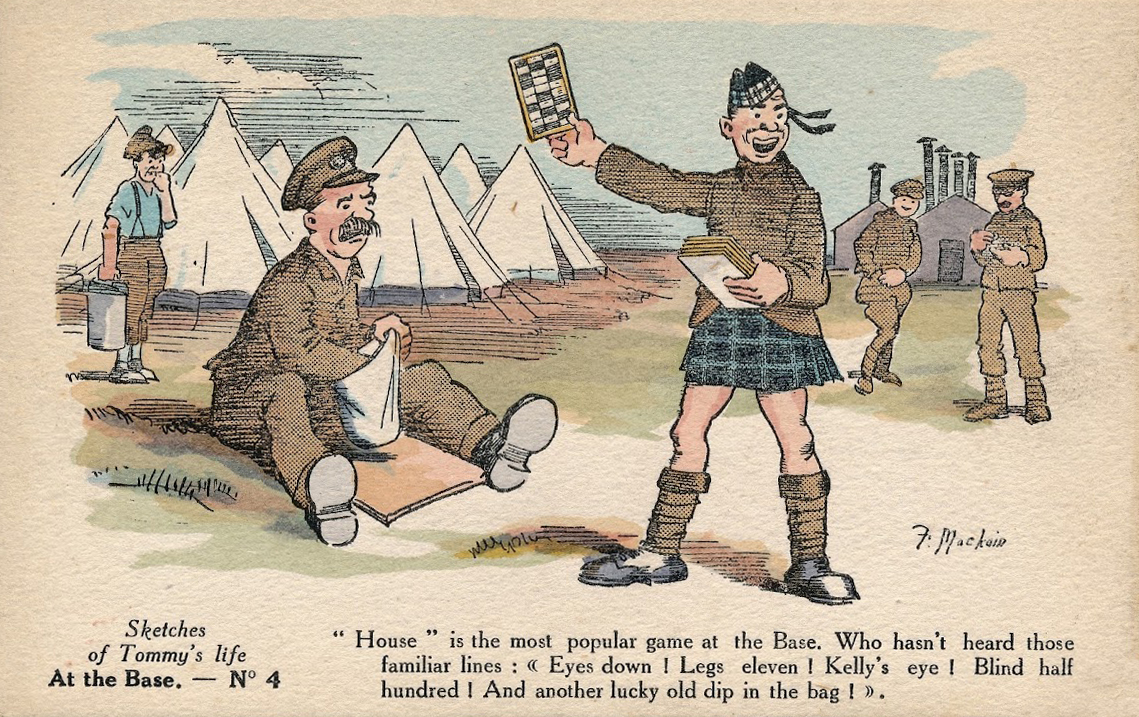
What was life like for Tommy Atkins during World War I? An ordinary soldier documented it in a series of drawings that were sold to those serving on the front line.
Today, the drawings, or cartoons, if you prefer, are revered as showing the true life experiences of little Tommy Atkins.
Tommy Atkins is the generic nickname for a private in the British Army, Tommy for short. The term’s origin is disputed.
No one has proven he was a real soldier, but three leading theories exist.
When the British War Office issued its Collection of Orders and Regulations (The Soldiers Book) in August 1815, the specimen form used Tommy Atkins as the name shown to indicate how it should be filled out.
While the War Office may have used an existing generic nickname rather than coining the term, because all serving soldiers would have seen the form, if it wasn’t the origin, it certainly helped popularise Tommy Atkins.
Another theory is that the name appeared in a letter sent from Jamaica referring to a mutiny among hired soldiers in 1743; it stated that Tommy Atkins behaved splendidly in dealing with the rebellion. No evidence of this letter exists.
The final theory is that the Duke of Wellington coined the name in honour of a soldier who died at the Battle of Boxtel in 1794. Again, there is no evidence of this either.
Whatever the origin of Tommy Atkins, by the start of WWI it was the colloquial nickname for a British private. And it was the name given to a series of Postcards created by Private Fergus Herbert Elgin Mackain.
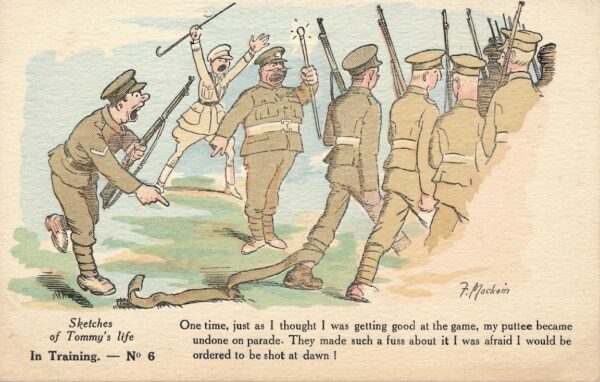 Mackain wasn’t even British; he was born on 28th March 1886 in Saint John, New Brunswick, Canada. His father, a civil engineer, emigrated from England around 1875, married, and had seven children; by 1890, he had moved with his family to the USA. At the start of WWI, Fergus was living in New York and working as an advertising illustrator. Leaving his wife and young family, he worked his passage on a horse-transport to join the British Army.
Mackain was very tall for the time, at 6 ft 3 inches, with a fresh complexion, fair hair and blue eyes.
He enlisted in the 30th (Service) Battalion, Royal Fusiliers on 2nd November 1915. The 30th was a reserve Battalion for the 23rd, which was famously known as the 1st Sportsman’s during World War I. Mrs Cunliffe-Owen privately raised it in 1914, with royal permission to accept men up to 45. At the time of enlisting, Fergus Mackain was 29.
The battalion drew heavily from well-known athletes, including champion boxers, cricketers, and footballers (hence its nickname), as well as Members of Parliament (MPs) and writers like John Buchan (who we will cover in a future post).
Emma Cunliffe-Owen set up the Battalion after a chance meeting with some friends. She was walking down Bond Street in London and ran into two big-game hunters she knew. Half-jokingly, she asked them why they hadn’t signed up, and they jokingly challenged her to raise a battalion of her own.
So she telegrammed Kitchener, and in September 1914, he accepted her offer to raise a battalion of fit men who could shoot and ride. Placing an advert in The Times, she and her husband set up an office at the Cecil Hotel in the Strand, seeking ‘Sportsmen, aged 19 to 45, upper and middle class only. Wanted at once.’
 Her campaign was so successful that the War Office asked her to raise a second battalion of 1,600 more men. So the 23rd and 24th (Service) Battalions of the Royal Fusiliers (City of London) Regiment were formed, otherwise known as the 1st and 2nd Sportsmen’s Battalions.
The irony is that Cunliffe-Owen was half German; she was the granddaughter of a German baron who had been aide-de-camp to Frederick Wilhelm of Prussia.
While training in England, Mackain began documenting his new army life in a series of cartoons. He sailed to France in 1916 and soon saw action in the Somme offensive at the Battle of Delville Wood. By July, just before the offensive, Fergus had transferred into the 23rd Regiment proper and travelled by train to the front line.
During the battle, the Sportsmen advanced under fire from hundreds of German machine guns. The Wood was largely intact before the battle, and the Germans had already held off a South African advance. Before the big push, the Germans bombed the area with gas shells. But just before 11 p.m., when they were to start, a breeze sprang up, so the Allies could move without wearing gas masks.
This attack had two objectives: first, to take a trench in the centre of the wood; second, to capture the far edge and dig in there.
This was the Battalion’s first time going over the top.
“At zero our barrage started, and our first waves were off, the thing I noticed most being that most of the men were smoking as they went over.
“The whole wood was immediately full of machine-gun bullets. There must have been hundreds of machine guns—up in trees, hidden in the undergrowth, in fact all over the place.
“The Hun artillery came down on all the approaches to the wood, but not on the wood itself so long as any of their own men were in it.”
“Owing to the position of the wood, however, at the apex of a captured triangle of ground, we received fire from both flanks, and also from our right rear, as well as from the front.
“The first objective was quickly taken, and then there was a pause before the advance to the second.
…
“The advance to the second objective started promptly, but the Hun fought hard for a time, and held us up. Every bush seemed to contain a machine gun, and a redoubt (a small, enclosed defensive fortification) on our left front caused us many casualties.
This redoubt contained several machine guns, with overhead cover, and a first-aid post. As soon as the C.O. received news of this check he sent up two reserve Lewis guns. These worked round the redoubt, and, finding an opening, killed most of the garrison, and then rushed it. The survivors fled, but Sergeant Royston found one of their own guns was still in action, and finished them off with it.
“The final objective was quickly reached and consolidated, and for a while our men had a pleasant time dealing with counter-attacks from the front. The field of fire was good, and they quickly dealt with all the attempts made to push us back. Our casualties, though, were very heavy, particularly amongst officers. At one time ‘A’ Company was commanded by Lance-Corporal Goodman, and another company by a Company Sergeant Major.
“Then the Hun artillery got busy on the wood, which was, of course, an ideal mark. For the rest of the day they simply poured heavy shells in. It was pretty terrible. Trees were torn up by the dozens, and fell blazing. By the end of the day there was nothing but shattered stumps.
“The Medical Officer had a busy time, and owing to the barrage could not evacuate his wounded. The aid post was filled, and the overflow had to be put in shellholes round about. The consequence was that many of them were killed as they lay there. Owing to the barrage, too, the sending of messages back to Brigade headquarters and the companies in front became almost impossible. Out of sixteen headquarter runners no fewer than fourteen became casualties before mid-day.
“One message was sent back by carrier pigeon, and a message received from the Brigadier read: ‘Hold on. Reinforcements are being sent.’ The reply of the C.O. was: ‘Of course we shall hold on. We are being hammered, but our tails are still up.’
“As the day wore on many efforts were made to get round our flanks and turn us out. Bombing parties crept up, and had to be dealt with by our bombers. It was in one of these tussles that Jerry Delany (the famous boxer) was killed.
“At one time word came from our comrades on the right that the Hun had broken through. So we sent over a party to their assistance, and finally repelled the attackers. We spent the whole of the afternoon and evening in this way, but when our relief came up that night we handed over the wood intact.
“The scene at night was awful, the wood being ablaze in many places. I read messages and wrote out the relief orders by the light of a blazing tree, which had fallen across the shell-hole then being occupied by Battalion headquarters.”1
There is a poem dedicated to the Sportsmen and the Battle of Delville Wood
THE SPORTSMEN
Sportmen of every kind,
God! we have paid the score
Who left green English fields behind
For the sweat and stink of war!
New to the soldier’s trade,
Into the scrum we came,
But we didn’t care much what game we played
So long as we played the game.We learned in a hell-fire school
Ere many a month was gone,
But we knew beforehand the golden rule,
“Stick it, and carry on!”
And we were a cheery crew,
Wherever you find the rest,
Who did what an Englishman can do,
And did it as well as the best.Aye, and the game was good,
A game for a man to play,
Though there’s many that lie in Delville Wood
Waiting the Judgment Day.2
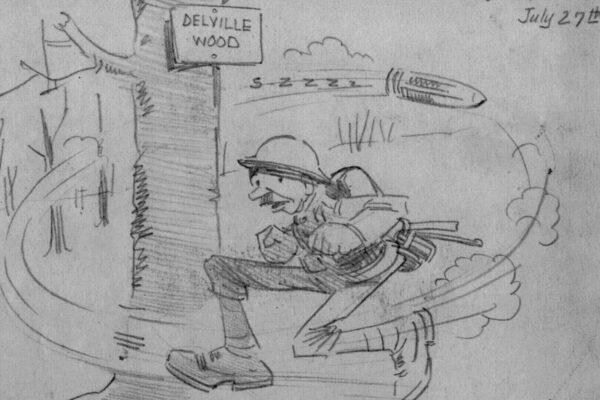 Fegus was wounded during the Battle of Delville Wood. And it was around this time that it is believed he contracted tuberculosis. He convalesced at Rouen Hospital, where Olive Swanzy was one of his nurses.
Swanzy collected a repository of pictures, poems and other documents given to her by the soldiers she cared for. Mackain gave Olive a drawing called ‘Last Lap’ that shows him being chased around a tree by a German artillery shell; the caption reads “Pte. F. E. Mackain busy capturing Delville Wood July 27th 1916”.
But it would be another 14 months before Mackain’s famous cartoons were commercially available.
His first to appear, on 9 October 1917, were a set of ten postcards, titled Sketches of Tommy’s Life In Training. This was followed by another set, on 1 November 1917, of ten more postcards, titled Tommy’s Life I At the Base. P. Gaultier initially published both sets. Later they were also printed by G. Savigny of Paris.
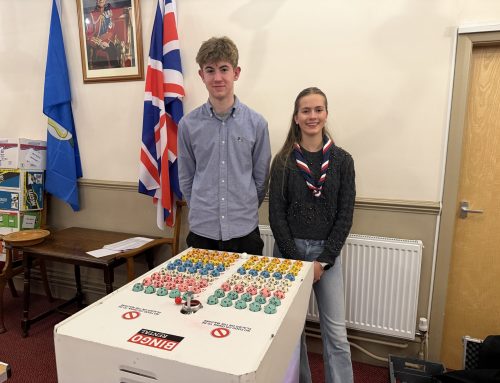
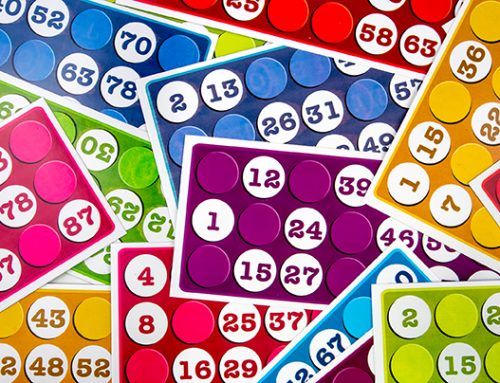
The card that is relevant to Bingo is number 4 in the At the Base set. Bingo was very popular during WWI; it was the only permitted gambling game. Fergus lists three Bingo Lingo calls on the postcard: Kelly’s eye, Legs eleven, and Blind Half Hundred, an old army call for 50.
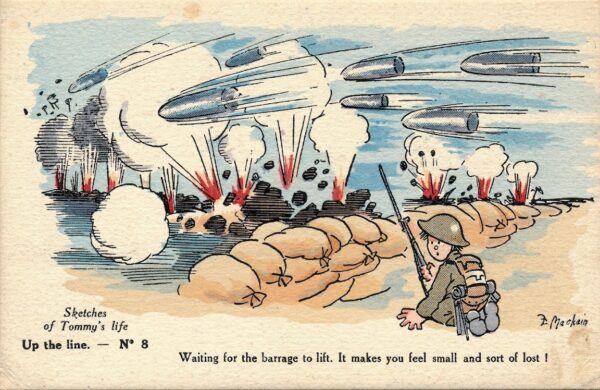
Two further sets were also released: Tommy’s Life Up the Line and Tommy’s Life Out on Rest, possibly around the same time as the first two; however, the publication date is unknown.
The first two sets include Visa Militaire, which indicates they were approved by wartime military censorship. All printed media during the First World War, including commercial postcards, sketches, and photographs, had to be reviewed and authorised by French military authorities before publication and public distribution to ensure no strategic information, sensitive location details, or troop movements were leaked, or public morale damaged.
The final two sets have Visa numbers 763 and 800, respectively, so a record likely existed, but there is no record of this today..
What is amazing about all of Macklain’s sketches is the attention to detail, which captures a true snapshot of what life was like for the British Tommy at the time.
After recovering from his wounds, Fergus was transferred to the Army Service Corps (ASC), which meant he was removed from further front-line duties. Whether this was because of his illness or maybe even because his artistic talent had been spotted, we will never know.
Macklain went on to publish further postcards, some very rare ones now, for Sammy (the nickname for American soldiers) as well as greeting cards.
Fergus survived the war and remained in England for a few years after. This may have been due to his Tuberculosis.
Trench conditions did not necessarily cause TB cases, but the cold, damp, malnutrition, and exhaustion rapidly reactivated undiagnosed or dormant infections. Over 90% of cases among British troops were pulmonary Tuberculosis, which is what Macklain suffered from.
Being in regular proximity to someone with active TB can lead to infection, as when they cough, sneeze, speak, laugh, or sing, they release tiny droplets containing the bacteria into the air.
It is estimated that over 55,000 returning service personnel were affected by the disease.
Effective treatments such as antibiotics like streptomycin did not exist at the time, so standard care relied on isolation, rest, and fresh air in specialised sanatoriums or outdoor wards.
Organisations like The Royal British Legion stepped in to help establish dedicated TB hospitals and rehabilitation villages (such as Preston Hall) to care for and house affected soldiers.
Fergus survived the war and remained in England until 1920, when he returned to his wife and young family in New York.
In 1923, with his health failing from his pulmonary tuberculosis, he was hospitalised at the Oteen Veterans Hospital, Asheville, North Carolina and died there on 3rd July 1924. He was just 38 years old.
Fergus Herbert Elgin Mackain 28th March 1886 – 3rd July 1924,
Further information
Fegust Mackain
https://www.mayhum.net/mckain_fergus_h_e.html
https://thefunkhole.co.uk/308600283/
Jerry Delany

Leave A Comment