
The book was filed away after being seized at the end of World War II; it is confiscated Nazi memorabilia, impounded by the American Armed Forces.
 In Germany, Russia, and France, the game was called Lotto or Loto.
While not the earliest ‘Bingo’ photos, they are important and have not been seen since the 1940’s. Although they are not dated, a camp inspection took place in 1915, so these photographs could have been taken during that review.
The 1915 inspection report of the Danish-Russian commission stated that the camp is commendable in all respects. It noted that while the barrack windows were somewhat small, and the rooms consequently dark, sufficient fresh air was provided. The report also cited the usual complaints about insufficient food. But it noted that, at least in Puchheim, prisoners with money could buy an extra loaf of bread.
Prisoners could earn this money through drainage work on the Puchheim moor, straightening and draining the Gröbenbach stream, as agricultural labourers, or by working in the yard of the municipal waste disposal company at the Puchheim train station.
The prison camp was originally an airfield. The site near Puchheim train station on Munich’s western outskirts was acquired in 1910 and became Bavaria’s first airfield.
 Gustav Otto, credited with founding BMW, ran his flight school there. The World War I flying ace Ernst Udet earned his pilot’s license at the airfield, after training with Otto. Udet was the second-highest-scoring German flying ace of WWI after Red Baron Manfred von Richthofen. He was the highest-scoring surviving ace of the war, joined the Nazi Party in 1933 and was involved in the early development of the Luftwaffe.
Munich’s Oberwiesenfeld airfield gradually overtook Puchheim’s popularity. With the outbreak of World War I and precarious finances, the site was sold to the state in 1915 to make way for the prisoner-of-war camp.
With 24,764 prisoners and 3,800 guards at the time of the armistice in 1918, the camp was significantly overcrowded, and it took until 1920 to finally close, when the last prisoners were returned home.
In 1977, the site became home to Puchheim Gymnasium, a grammar school specialising in languages, science, and technology, and now hosts nearly 1,100 students.
The two bingo photos are in a book from what was known as the Rehse Collection. The collection began as a private museum and archive in Munich, Germany, founded by Friedrich Josef Maria Rehse. Because Rehse was a photographer and based just down the road from Puchheim in Munich, he may well have taken the photos, though we have no proof of this.
In 1914, Rehse began compiling a collection of contemporary historical documents. Later, he documented what he called the Jewish-Marxist propaganda he saw being used against Germany, and the traitors who allowed the post-war plundering of Germany through murder, intrigue and the inflation of German currency. Rehse also documented the rise of the Nationalsozialistische Deutsche Arbeiterpartei (NSDAP, the Nazi Party) from its first days in January 1919.
In 1929, at the behest of Hitler, the Nazi Party acquired the collection for 80,000 Reichsmarks. After this Rehse still managed the collection, and he later joined the party in 1937.
At the end of World War II, the American Armed Forces confiscated the collection and took it to the United States. Later, a large part of it was transferred to the German Federal Archives, but portions remain in the Library of Congress. This is where the book of 43 photos resides as LOT 3635 today.
The listing states that the prints measure 18 x 24 cm and are numbered from 2 to 44, with some numbers omitted or unnumbered, and that 1 print is missing.
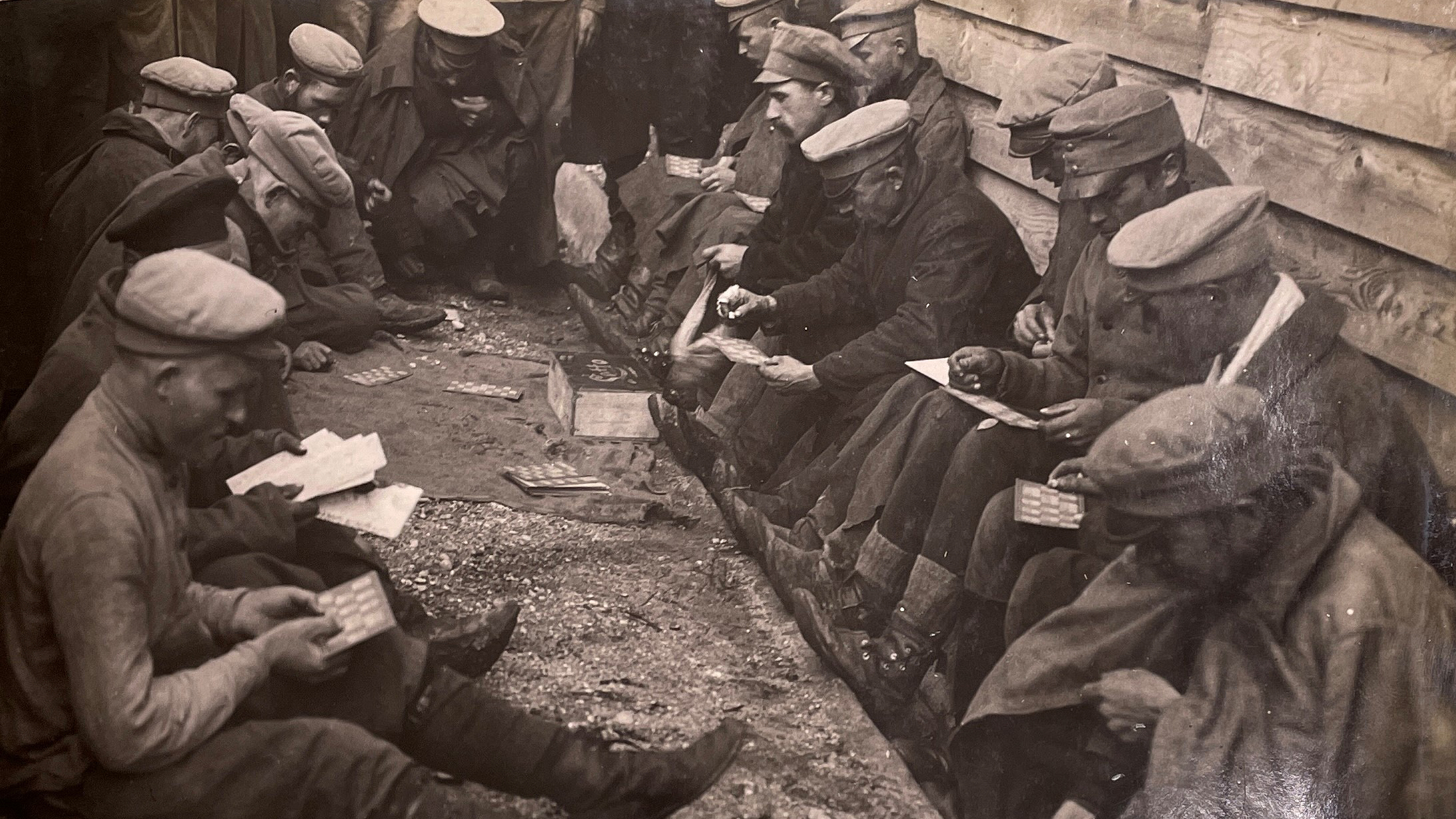
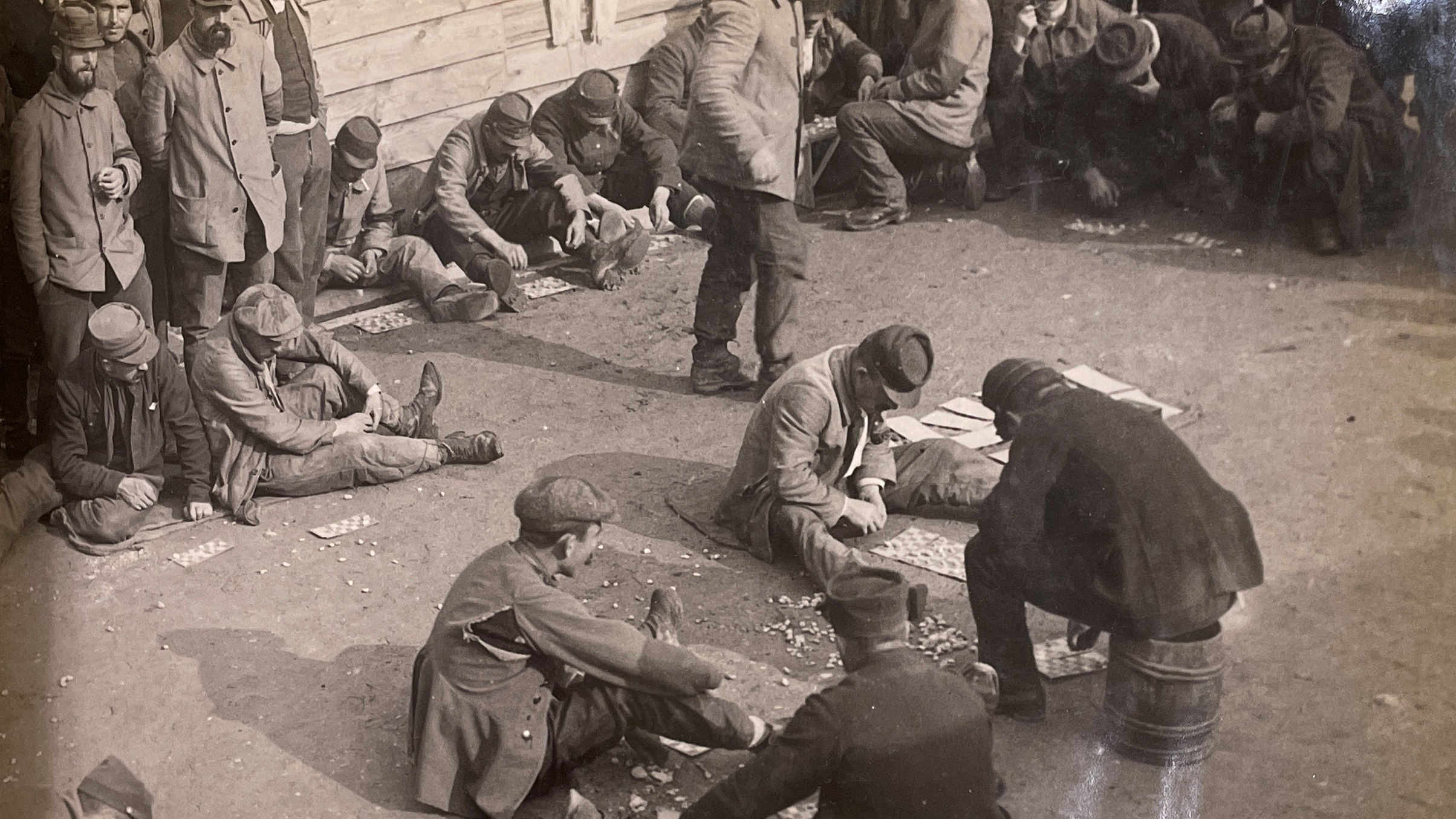
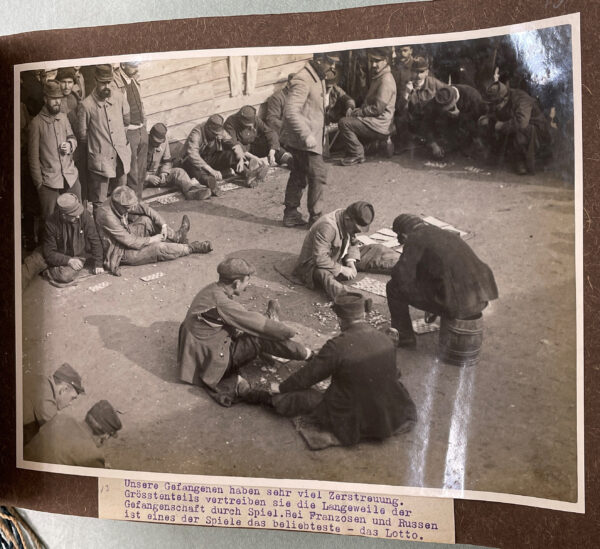
The two bingo photos are numbered 13 (pencil) and 19.
Because the images aren’t currently digitised, I asked the Prints & Photographs Division at the Library of Congress whether there’s a way to access them today. Reference Librarian Kate Phillips very kindly found the book and took pictures with her phone, which is what you see here.
The captions read:
No. 13. Unsere Gefangenen haben sehr viel Zerstreuung. Grösstenteils vertreiben sie die Langeweile der Gefangenschaft durch Spiel. Bei Franzosen und Russen ist eines der Spiele das beliebteste – das Lotto.
No. 13. Our prisoners have plenty of ways to pass the time. For the most part, they stave off the boredom of captivity through games. Among the French and Russians, one game is the most popular: lotto.
No. 19. Russen beim Lottospiel.
No. 19. Russians playing lotto.
Special Thanks to Kate Phillips, Reference Librarian, Prints & Photographs Division, Library of Congress, for taking and providing the photos. And Alexander Rotter, History teacher at Puchheim Gymnasium, for his excellent article about the History of Puchheim.

Leave A Comment